Szerző: Ügyvédi Iroda
If you produce online content — whether articles, blog posts or professional materials — there is a good chance Google Gemini has already used your text. A Hungarian publisher decided not to let that slide and sued Google. The case is now before the Court of Justice of the European Union. The ruling on AI copyright (Hungarian: AI szerzői jog) could set a continent-wide precedent, directly affecting how anyone can protect their intellectual property in the age of artificial intelligence.
Why Is All of Europe Watching a Hungarian Publisher’s Lawsuit?
How a regional news portal became an EU-level case
Case C-250/25 was brought by the publisher of a Lake Balaton regional news portal, challenging Google’s practice of using the outlet’s editorial content in its chatbot. What makes the case unique is that the claimant is the press publisher itself — not the individual journalists — which matters because EU law grants publishers and authors distinct sets of rights. The Budapest Regional Court ultimately referred preliminary ruling questions to the CJEU, opening the door to a Luxembourg proceeding whose outcome could reshape the entire European digital content industry.
The European dimension
At the oral hearing in March 2026, five EU Member States and the European Commission itself submitted observations alongside the parties. In our legal practice, this level of intervention is highly unusual — it typically signals that the expected ruling will have directive-interpretation effects far beyond the underlying dispute. The Commission argued that the legal assessment should not depend on technical abstractions, as the resulting knowledge asymmetry would put smaller rightsholders at a disadvantage against major tech companies.
How Does Protected Content End Up Inside a Language Model?
The legality of AI training on copyrighted works — a legal perspective
The legality of AI training on copyrighted works (Hungarian: AI betanítás jogszerűsége) is one of the most contested questions in technology law today. Large language models learn by converting billions of online texts into mathematical patterns. Developers argue that the original text is effectively destroyed in the process, leaving only abstract statistical relationships. This reasoning, however, is far from settled: if someone reads through an entire library and then commercialises the knowledge gained, that does not extinguish the copyright on the works consulted. None of the major AI developers publicly disclose which protected works have been included in their training data — and this lack of transparency is itself a serious concern.
When the machine paraphrases from protected sources
The other critical issue is what appears on the user’s screen. From the standpoint of copyright protection of AI generated content (Hungarian: AI generált tartalom szerzői jogi védelme), the decisive question is how closely chatbot responses mirror original sources. At the Luxembourg hearing, the developer acknowledged that original text elements may recognisably surface in responses, and that there is currently no filter capable of preventing this automatically. This involuntary admission carries significant legal weight, as it undermines the argument that no copyright infringement can arise on the output side.
The Legal Framework: Where Are the Boundaries?
Text and data mining: exception or rule?
Article 4 of the DSM Directive (2019/790) provides a general text and data mining (TDM) exception: anyone — not just research institutions — may carry out automated text analysis on lawfully accessible content, provided the rightsholder has not expressly opted out using machine-readable means (such as a robots.txt file). When the legislator drafted this provision in 2019, it could hardly have anticipated that it would later become the legal foundation for AI products generating billions in revenue. One of the central questions in this case is precisely whether exceptions designed for research and innovation can be extended to systems whose primary purpose is commercial gain. If the CJEU answers in the negative, generative AI providers across Europe would need to obtain licences from rightsholders.
The publishers’ dilemma: block or become invisible?
While a technical mechanism exists for publishers to block the AI-related processing of their content, reality is more nuanced. In our legal practice, we regularly encounter the dilemma that an online content producer cannot afford to disappear from search engines — yet where the opt-out signal and search indexing are controlled by the same provider, the separation of the two systems is not necessarily guaranteed. This issue could also engage the Digital Markets Act (DMA) and EU competition law, although that analysis is more likely to become relevant in the Hungarian base proceedings than in Luxembourg.
What Questions Must the Court of Justice Answer?
Four questions the future of the AI industry may depend on
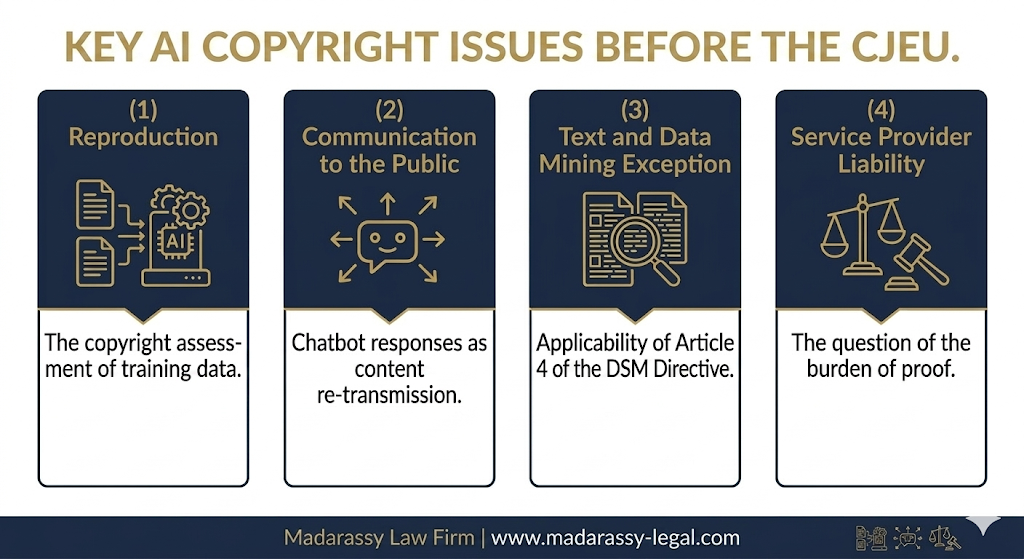
The questions referred by the Hungarian court rest on four pillars. First: does the machine processing of original texts during training constitute reproduction under EU law? Second: if protected content is recognisable in a chatbot’s response, can that be considered communication to the public? Third: does the DSM Directive’s general TDM exception apply to commercial text mining for AI? Fourth: if infringement is established, under what liability framework can it be attributed to the service provider? The last question is particularly noteworthy, as it raises the prospect of reversing the burden of proof — requiring the AI provider to demonstrate that its operations are lawful.
How Is the Relationship Between Artificial Intelligence and Copyright Law Evolving Globally?
US lawsuits and a historic settlement
The Google Gemini Hungarian lawsuit (Hungarian: Google Gemini magyar per) can best be understood in the context of international AI copyright developments. In the United States, several major publishers and author communities have filed suit against AI developers, alleging that their content was incorporated into training data without authorisation. One of the most high-profile outcomes was a 2025 settlement in which a leading AI developer agreed to pay approximately USD 1.5 billion in damages to book authors. This precedent sends a clear message: enforcing rights through litigation is not merely a theoretical option — it can produce economically significant results.
What Is the European Parliament Doing in 2026?
Transparency, remuneration, registration
In early 2026, the European Parliament’s Committee on Legal Affairs adopted a package of recommendations built on three pillars. First, AI providers would be required to disclose which copyrighted works were used to train their models. Second, rightsholders would be entitled to fair remuneration. Third, a European register of used works would be established at EUIPO. The proposal also states that content generated exclusively by artificial intelligence and copyright law would not intersect in terms of protection — purely AI-created works would remain ineligible for copyright. It is important to note that this is an own-initiative parliamentary resolution for now — binding legislation remains in the hands of the European Commission.
Traffic Diversion: Why Does It Threaten the Entire Content Industry?
When the reader closes the chatbot satisfied
The economic stakes of this case are no less serious than the legal ones. If a user can obtain the substance of an article from a chatbot response, why visit the original website? Each missed click means lost advertising and subscription revenue — and on a mass scale, it erodes the entire publishing business model. The paradox is worth considering: if content producers become financially unviable, the AI systems themselves will eventually find less fresh, reliable text to learn from. As a content producer, we recommend monitoring your website’s organic traffic now — if you notice a downward trend coinciding with the spread of AI-powered search, that could be an early warning sign.
What Can We Expect? Possible Outcomes and Their Impact
Timeline: the decision is not coming tomorrow
The Advocate General’s Opinion is expected in September 2026, with the CJEU’s final ruling potentially following months later. It is important to understand that the Luxembourg court will not decide the Hungarian base case on its merits — it will provide the correct interpretation of EU directives, while the assessment of the specific facts and the final judgment remain within the jurisdiction of the Budapest Regional Court. The case may therefore continue to occupy the courts for years to come.
Two scenarios — and a likely middle ground
If the CJEU interprets publishers’ rights strictly, AI developers will need to obtain consent and pay fees for the use of copyrighted content. This would fundamentally alter the economics of AI copyright in Europe. If, on the other hand, the Court applies the TDM exception broadly, rightsholders will be left with the burdensome and expensive path of individual litigation. Our professional expectation is that the CJEU will take a differentiated approach, treating the training and output phases differently — potentially laying the groundwork for a nuanced new body of case law. On the training side, the Court may not categorically exclude the TDM exception, but is likely to scrutinise its conditions rigorously — particularly the practical effectiveness of opt-out mechanisms. On the output side, where protected text recognisably appears in chatbot responses, a harder line can be expected, as the link between communication to the public and publisher revenue loss is directly demonstrable.
How Can You Protect Your Intellectual Property in the Age of AI?
Practical steps for content producers and businesses
AI copyright is not just a problem for tech companies — it affects every business with an online presence. As a practical step, consider configuring robots.txt and meta tag-level blocks against known AI crawlers if you do not wish your content to be available for training purposes. Review your existing licence agreements to check whether they address AI-related usage rights. Conduct an internal copyright audit of your published content. And finally, do not wait for the ruling: the regulatory landscape is shifting rapidly, and proactive legal preparation is always more cost-effective than enforcement after the fact.
Madarassy Law Firm has over 20 years of experience advising clients on copyright, technology law and data protection matters.
If you need legal advice on AI copyright — whether it concerns content protection, contract review or regulatory compliance — do not hesitate to contact us.
Visit our website: www.madarassy-legal.com