Szerző: Ügyvédi Iroda
If you are a foreign business leader or investor planning to establish a presence in Hungary, the first and most important decision is not office space or hiring — it is choosing the right legal structure. Company formation in Hungary for foreign companies (Hungarian: cégalapítás Magyarországon külföldi cégeknek) is possible through three distinct routes, each carrying different risks, tax consequences, and operational flexibility for the parent company. This guide will help you identify which route suits your business — and why it is worth doing it with an experienced attorney.
Why Should Foreign Companies Choose Hungary?
The 9% Corporate Tax Rate and Access to the EU Single Market
Hungary’s corporate tax rate (TAO) remains 9% in 2026 — one of the lowest in the European Union, and a significant competitive advantage in its own right. EU membership means that a company registered in Hungary has unrestricted access to the European single market. Dividends paid to foreign shareholders are generally not subject to withholding tax, and Hungary’s extensive network of double taxation treaties further reduces the cross-border tax burden.
Fast Incorporation, Low Share Capital, Investor-Friendly Environment
Incorporating a limited liability company in Hungary typically takes 4–5 business days; the minimum share capital is just HUF 3,000,000 (approx. EUR 8,300) — an exceptionally low entry threshold by European standards. Foreign companies can establish a single-member Kft. without any nationality restrictions, and the HIPA (Hungarian Investment Promotion Agency) offers additional administrative support to facilitate market entry.
Double Taxation Treaties and the Global Minimum Tax
Hungary has signed double taxation treaties with more than 80 countries. One important exception: multinational groups with consolidated revenues exceeding EUR 750 million are subject to the GloBE (global minimum tax) rules, which require a minimum effective tax rate of 15% — partially offsetting the benefit of the favourable 9% corporate tax rate. This should always be factored into structural planning.
Foreign Company Presence in Hungary: Three Legal Structures, Three Different Logics
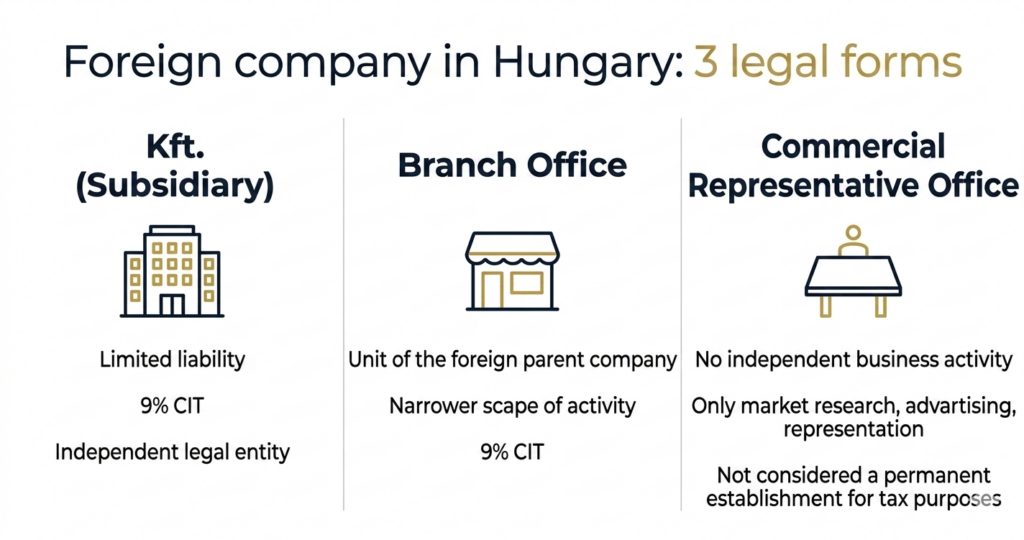
The Kft. as an Independent Subsidiary: Limited Liability, Full Autonomy
The Kft. (Hungarian limited liability company, similar to an LLC) is a fully independent legal entity: the parent company’s liability for the subsidiary’s obligations is generally limited to the subscribed share capital, protecting the foreign company’s own assets. The Kft. can enter into contracts, employ staff, and take out loans entirely in its own name. For long-term, stable operations in Hungary, this is by far the most common and recommended structure.
The Branch Office: Operational Independence, but Unlimited Parent Company Liability
Under Act CXXXII of 1997, a branch office is an organisational unit of the foreign company — registered as a separate corporate form but without legal personality. It can conduct business independently, but the parent company bears unlimited and joint liability for all obligations incurred by the branch. All of the parent’s assets located in Hungary are subject to enforcement. Both the branch office and the Kft. are subject to corporate tax and the innovation contribution levy (0.3%).
The Representative Office: Market Exploration with Minimal Risk
A representative office cannot conduct independent commercial activities in its own name — it may only mediate contracts, conduct negotiations, and carry out promotional activities on behalf of the foreign company. It is not subject to the innovation contribution levy, and its administrative burden is the lightest of the three structures. This option suits companies that are exploring the Hungarian market before committing to a more substantial investment.
Branch Office or Subsidiary for Foreign Companies in Hungary — How Should You Decide?
Liability and Risk from the Parent Company’s Perspective
The most critical factor in choosing between a branch office or subsidiary for foreign companies in Hungary is the scope of liability. With a Kft., the parent’s exposure is capped at the share capital — the foreign company’s own assets are not at risk. With a branch office, the opposite is true: the parent bears full liability, and all its Hungarian assets are subject to enforcement. This single difference often determines the choice.
Tax and Accounting Obligations Compared
Both structures must maintain accounting records and file annual financial statements under Hungarian accounting law. In the case of a branch office, transfer pricing rules also apply to transactions with the parent company — arm’s length prices must be applied to all intra-group transactions, and transfer pricing documentation is mandatory. This is a significant administrative overhead that should be factored into choosing the right legal structure for foreign companies in Hungary.
When Is a Branch Office the Right Choice, and When Is a Kft. Better?
For short-term or exploratory operations where easy exit is a priority, a branch office can offer more flexibility — no minimum share capital is required, and winding up is simpler. For long-term, fully independent operations, large-scale employment, property acquisition, or bank financing, the Kft. is the safer and commercially more credible structure.
How to Set Up a Company in Hungary as a Foreign Investor in 2026: Step by Step
Preparing the Parent Company’s Documents: EUID, Company Extract, Apostille
Since 2023, EU/EEA parent companies holding a European Unique Identifier (EUID) benefit from a significant simplification: the Court of Registration can access their data directly, so no company extract or certified Hungarian translation needs to be filed. For non-EU parent companies, however, a company extract not older than 3 months, its certified Hungarian translation, and — where required — an apostille are all mandatory. Missing any of these will halt the entire procedure.
Appointing a Service of Process Agent: Mandatory and Critical
Every member or managing director who does not have a registered address in Hungary must appoint a service of process agent in the company register. Importantly, the company’s own members or directors cannot serve in this role. The law presumes that any official document properly served on the agent becomes known to the foreign party within 15 days — failure to act on such documents can lead to serious legal consequences.
The Registration Process and Opening a Bank Account
The attorney drafts and countersigns the articles of association, completes the mandatory JÜB (Hungarian mandatory client identification system) identity verification, and then files the registration application electronically with the competent Court of Registration using a digital signature. The tax number is issued automatically upon registration; however, the managing director is generally required to appear in person in Budapest to open the company’s bank account — this should be factored into the incorporation timeline.
What Should a Foreign Investor Watch Out for After Incorporation?
Tax Registration and Initial Obligations
Tax authority registration begins in parallel with company registration. VAT registration, the innovation contribution levy, and local business tax advance payments must each be addressed separately. Late or incomplete filings with the NAV (Hungarian Tax Authority) carry penalty risk — the first few months of compliance require close attention.
Special Notification Obligations for Strategic Investors
Under Act LVII of 2018, investors from outside the EU, EEA, and Switzerland must file a prior notification with the Minister responsible for economic affairs if the transaction value reaches HUF 350,000,000 (approx. EUR 970,000) and the acquired stake is at least 5% in a strategic company. Failure to notify may render the transaction void.
Transfer Pricing and Annual Compliance: Don’t Overlook It
Transactions between the parent company and the Hungarian entity must be conducted at arm’s length, with proper transfer pricing documentation. This is a priority area for NAV audits. Inadequate documentation can result in substantial tax penalties — it is strongly advisable to put compliant records in place from the very first year of operation.
Setting Up a Kft. in Hungary as a Foreign Company with an Attorney — What the Law Requires
Legal Requirement: Company Formation in Hungary Is Only Possible Through an Attorney
Under Act V of 2006 (the Company Registration Act, Ctv.), the registration application can only be filed by an attorney, electronically, using a qualified digital signature. This is a statutory requirement, not an option — setting up a Kft. in Hungary as a foreign company with an attorney is not merely recommended but legally mandatory. This also provides a guarantee: the attorney bears full professional responsibility for the lawfulness of the process.
What Does the Attorney Do on Behalf of the Foreign Founder?
The attorney conducts the mandatory JÜB client identification, drafts and countersigns the articles of association, verifies the formal and substantive compliance of all foreign documents, coordinates the appointment of a service of process agent, and manages the entire process from signing through to registration. The foreign founder only needs to provide the relevant data and sign the documents.
Why Does the Law Firm’s International Experience Matter?
Foreign documents — particularly from non-EU companies — often arrive in formats that reflect different legal traditions. Apostille references, foreign-language signatory authorisations, and the content of company extracts all require specialist knowledge to assess. An experienced law firm with a proven international track record minimises the risk of rejection by the Court of Registration — saving the foreign investor significant time and cost.

The Three Most Common Mistakes When Entering the Hungarian Market
Wrong Legal Structure — The Hidden Liability of a Branch Office
Many foreign companies opt for a branch office without realising that their entire Hungarian asset base is exposed to enforcement proceedings. This is a decision that is very difficult to reverse after the fact.
Incomplete Documents in the Registration Procedure
A missing apostille, translation, or EUID will bring the entire registration to a halt. This is entirely avoidable if the attorney checks the complete document package from the outset.
Misidentifying Tax Residence
If actual management and control is exercised from Hungary, Hungarian tax obligations may arise regardless of where the company is formally registered — this is one of the most frequent targets of NAV tax audits.
Company Formation in Hungary for Foreign Companies — What Does an Experienced Law Firm Offer?
Full Coordination: From the First Step to Registration
Madarassy Law Firm has over 20 years of experience coordinating company formation in Hungary for foreign companies — from document preparation through Court of Registration filing to NAV notification. The firm communicates in English and German, works directly with the parent company’s legal representatives, and requires minimal administrative effort from the client. We manage the entire process.
Ongoing Legal Support: Contracts, Labour Law, Data Protection, Compliance
Successful incorporation is only the beginning. Day-to-day operations in Hungary continuously raise legal questions — employment matters, commercial contracts, GDPR compliance, regulatory proceedings. Our firm provides a single point of legal contact, so there is no need to coordinate multiple advisers: corporate law, labour law, data protection, and compliance are all handled within one experienced team.
The First Step Is the Most Important — Don’t Take It Without a Lawyer
What Do You Learn in the First Consultation?
A single brief consultation is enough to clarify the right legal structure, the expected timeline and cost of incorporation, the required document checklist, and any relevant strategic considerations — notification obligations, GloBE applicability, transfer pricing. At an experienced law firm, the first consultation is genuinely solution-oriented, not merely exploratory.
How to Contact Madarassy Law Firm
Madarassy, Bodroghelyi & Partners Law Firm (Budapest, 1117 Váli utca 4.) has guided foreign clients through company formation in Hungary for foreign investors for over 20 years — in English and German. To book a consultation, visit www.madarassy-legal.com.
Planning company formation in Hungary for foreign companies? Madarassy Law Firm has been guiding international businesses into the Hungarian market for over 20 years — from choosing the right legal structure through registration to ongoing legal support. Get in touch: www.madarassy-legal.com