Szerző: Ügyvédi Iroda
In Hungary, nearly 25,000 marriages end in divorce every year — and in most cases, the division of assets turns into a dispute that drags on for years. Yet all of this can be avoided with a prenuptial agreement (Hungarian: házassági szerződés) countersigned by a lawyer: it offers effective protection in situations involving business debt, creditor enforcement, or inheritance conflicts. We’ve put together the key facts on when it’s worth getting one, what it costs, and which misconceptions to let go of immediately.
What Is a Prenuptial Agreement — and Why Isn’t It Just for the Wealthy?
Community Property: What Becomes Jointly Owned the Moment You Marry?
Most couples don’t realise it, but from the day of the wedding, a legal regime kicks in automatically — one that nobody consciously chose. The Hungarian Civil Code (Ptk.) calls this the community property regime: everything either spouse acquires during the marriage — salary, real estate, savings — automatically becomes jointly owned. The same applies to debts: if one partner takes out a loan, the other is equally liable. Many people only discover at the point of divorce that their spouse has a legal claim to what they thought of as “their” flat, car or business stake.
The Three Property Regimes, Simply Explained
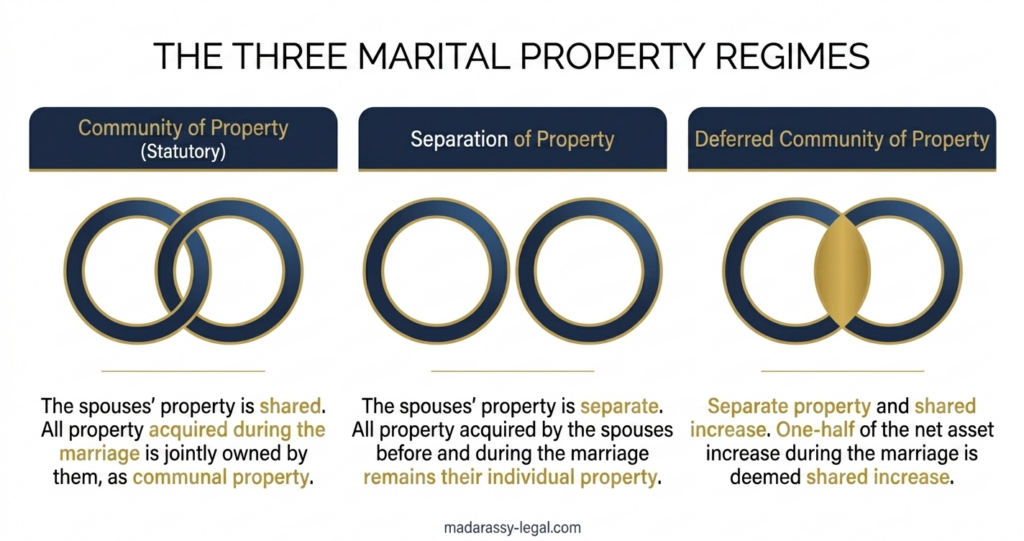
Hungarian law offers three frameworks for managing marital finances. The first is the community property regime, which applies automatically without a contract. The second is separation of property (Hungarian: különvagyon): under this arrangement, each spouse remains an entirely independent owner throughout the marriage — according to data from the Hungarian Chamber of Notaries (MOKK), 61% of registered contracts choose this option. The third is the deferred community of property regime: spouses manage their assets separately during the marriage, but when the marriage ends, they share the wealth each has accumulated. In simple terms: everyone handles their own money freely during the marriage — a spouse’s creditors cannot touch the other partner’s assets — but at the end of the marriage, the total gains are tallied up and the spouse who gained less can claim half the difference from the other. A useful rule of thumb: entrepreneurs tend to be best served by the deferred community model, while a large initial wealth gap typically points toward full separation of property.
When Should You Get a Prenuptial Agreement?
Before or After the Wedding? Both Are Possible — This Is the Most Common Misconception
One of the most widespread misunderstandings is that a prenuptial agreement can only be signed before the wedding. Section 4:66 of the Hungarian Civil Code explicitly states that spouses may enter into or amend a marital property agreement at any point during the marriage — either for the future or to settle the fate of assets already accumulated together. The idea that “it’s too late” is simply wrong. The genuinely optimal moment is whenever both parties can negotiate calmly and on equal terms — ideally well before any tension arises.
The Most Common Situations Where a Prenuptial Agreement Is Essential
Based on legal experience, five situations arise most frequently when couples decide to formalise a marital property agreement. The first is when one partner runs or is starting a business. The second is when one party enters the marriage with significant separate assets — inherited property or substantial savings. The third is a second (or later) marriage, especially where children from a previous relationship are involved. The fourth is an unequal contribution to a property purchase, where the parties are not contributing equally to the price. The fifth is where one spouse is taking on a loan and the other’s assets need to be protected from the consequences. In any of these situations, a single consultation with a lawyer is enough to establish exactly what is needed.
Separate Property and Joint Assets: What Does the Agreement Actually Protect?
Property, Savings, Inheritance — What Stays Yours?
Under Hungarian law, separate property includes assets acquired before the marriage, inherited assets, gifts, and anything purchased using separate property funds. The difficulty arises where separate and joint assets overlap: if a flat owned before the marriage is renovated using shared money, or if one spouse’s inheritance is used to cover joint mortgage repayments, the situation can become virtually impossible to reconstruct years later. A prenuptial agreement allows these facts to be recorded precisely — in our legal experience, without such a document, asset division proceedings can drag on for four to twelve years.
HÉVSZENY Registration: The Critical Step Many People Skip
A signed prenuptial agreement is only enforceable against third parties — banks, creditors, enforcement officers — if the couple registers it in the National Register of Matrimonial and Cohabitation Property Agreements (HÉVSZENY). This registration costs just HUF 10,000 (approximately €28) and is handled before a notary, yet many couples skip it. Without registration, the agreement remains valid between the spouses themselves, but a bank or enforcement officer with no knowledge of its existence is not bound by it. Your lawyer will typically flag this point and can assist with the registration process.
Why Is a Prenuptial Agreement Especially Important for Entrepreneurs?
Joint Assets and Enforcement: The Hidden Risk
If one spouse runs a business, the community property regime can carry serious consequences: a company’s creditors may initiate enforcement proceedings that extend to the entire jointly-owned estate. This means the non-business-owning spouse — who may have had nothing to do with the company’s decisions — can lose jointly acquired property or savings. This risk is manageable with the right contract in place, and running a business does not have to put the entire family’s financial security at stake.
Deferred Community of Property for Entrepreneurs: Protection in Divorce and Insolvency Alike
For entrepreneurs, the deferred community of property model offers the best balance: assets are managed separately during the marriage, so business-related risk does not spill over onto the non-business-owning partner’s estate. If a divorce does occur, accumulated wealth can be shared proportionally, preventing either party from ending up in an unfairly disadvantaged position. This arrangement protects against creditors and future asset disputes at the same time.
The Legal Requirements for a Valid Prenuptial Agreement — What Many People Get Wrong
Two Witnesses Are Not Enough: Why a Lawyer or Notary Is Mandatory
Section 4:65(1) of the Hungarian Civil Code (Ptk.) is unambiguous: a prenuptial agreement is only valid if it takes the form of a notarial deed or a private document countersigned by a lawyer. Two witnesses’ signatures alone are not sufficient — this is one of the most common and costly mistakes couples make. Both parties must sign the agreement in person; it cannot be concluded through a representative.
Asset Inventory vs. Prenuptial Agreement: A Distinction That Matters
Many people confuse these two documents, but they are fundamentally different. An asset inventory simply records the current financial position of the parties; it does not change the legal property regime and therefore offers no real protection on its own. A prenuptial agreement, by contrast, actively sets the rules for future property relations and establishes a framework that differs from the statutory default. Anyone who relies on an asset inventory alone may be operating under a false sense of security.
Prenuptial Agreement Lawyer Fees (Hungarian: ügyvédi díj): What Does It Actually Cost?
Lawyer or Notary? Which Should You Choose and Why?
A prenuptial agreement can be validly concluded with a lawyer’s countersignature — it does not have to be drawn up before a notary. The two forms carry equal legal weight and both can be registered in HÉVSZENY. The lawyer route tends to be more flexible and tailored to the individual situation; notarial fees are set by statutory tariff and can be higher when the property situation is more complex. From a practical standpoint, using a lawyer means the drafting and legal advice happen under one roof, which simplifies the whole process.
What Should You Budget, and What Does the Fee Cover?
Lawyer fees for a prenuptial agreement in Hungary typically range from HUF 75,000 to HUF 350,000 plus VAT (approximately €200–€970), depending on the complexity of the agreement. For a straightforward separation-of-property arrangement, the lower end of that range is realistic; if multiple properties, business stakes or loan securities are involved, a higher fee is warranted. The fee generally covers the initial consultation, drafting the agreement and the lawyer’s countersignature. The HÉVSZENY registration fee of HUF 10,000 (~€28) is charged separately and handled before a notary.

A Well-Drafted Prenuptial Agreement Lasts Decades — Don’t Leave It to Chance
A prenuptial agreement is not a sign of distrust — it is a tool for responsible, forward-looking planning. The right time to put one in place is when both parties can negotiate calmly and on equal terms, not when tensions have already become insurmountable. Whether you are planning a wedding or have been married for years, a single consultation is enough to find out whether you need an agreement — and if so, which property regime suits your situation.
Madarassy, Bodroghelyi & Partners Law Firm brings decades of experience to helping clients think through matrimonial property questions and drafting prenuptial agreements — from selecting the right property regime and countersigning the document to handling HÉVSZENY registration. If you want your assets and your future to be on solid legal ground, we welcome you to get in touch for an initial consultation.