Szerző: Ügyvédi Iroda
With the entry into force of the Attorney Activities Act (Act LXXVIII of 2017, known as “Üttv.”), the number of proceedings requiring mandatory legal representation in Hungary rose to 99 — a figure unmatched across Europe. Yet hiring a corporate lawyer in Budapest is not a luxury but a fundamental requirement for the day-to-day operation of any business. Poorly drafted contracts, employment law oversights and unreported changes in company data can result in penalties running into millions of forints (approx. EUR 2,700 per HUF 1 million). This guide walks you through everything you need to know before choosing a lawyer for your company.
Why Is Legal Support Indispensable for a Business?
The complexity of the regulatory environment and managerial liability
A Budapest-based business faces a constant stream of legal obligations — from corporate law and employment law to data protection and public procurement rules. The Hungarian Civil Code (Ptk.), the Companies Act, the Labour Code and numerous sector-specific regulations together create an environment in which legal unawareness is itself a risk factor. Under the Ptk., a managing director’s personal liability may extend to their private assets if the company’s decisions breach the law.
What can it cost if you have no lawyer?
A poorly worded contract, a missed filing at the Court of Registration or an unlawful employer action can trigger a chain reaction whose cost far exceeds the price of prevention. The Court of Registration may initiate supervisory proceedings, the labour authority may impose fines, and a contracting partner may file a damages claim. Virtually all of these situations can be prevented with proper legal support.
When Does a Company Need a Lawyer? — Mandatory and Recommended Cases
Legally required attorney involvement
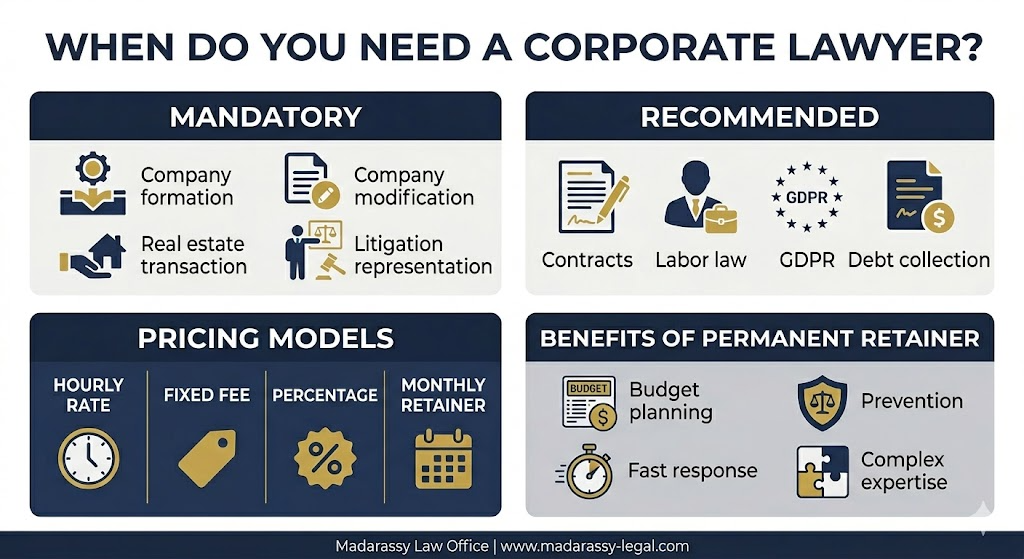
Hungarian law prescribes mandatory legal representation in a wide range of areas. Under Section 32(4) of the Hungarian Companies Act, only an attorney may act in company registration and change-registration proceedings. The Land Registry Act requires a contract countersigned by an attorney for the registration of ownership rights. Legal representation is also mandatory in commercial litigation and in proceedings before the Regional Court of Appeal. Company formation, registered seat changes, changes of managing director, capital increases — none of these can proceed without an attorney.
When it is not mandatory but critical
Beyond the mandatory cases, an attorney’s involvement is essential in everyday business operations. The professional drafting of commercial contracts, supplier agreements and NDAs has a dispute-prevention effect. Ensuring the legality of employment documentation — employment contracts, internal policies, terminations — protects the business from labour disputes. GDPR compliance, debt collection and communication with public authorities are likewise areas where proactive legal advice translates into savings.
How to Choose a Corporate Lawyer in Budapest?
Why does the size and capacity of the law firm matter?
One of the most commonly underestimated factors in choosing a lawyer is the size and composition of the firm. A mid-sized or larger law firm (Hungarian: ügyvédi iroda) offers structural advantages that a sole practitioner simply cannot match. When a business owner calls at eight in the morning with an urgent contract question, a multi-attorney office always has a colleague available — unlike a sole practitioner who may be sitting in a court hearing. Substitutability is not a matter of convenience but a business necessity: a company’s legal affairs cannot wait for days.
Even more important is the breadth of expertise. In the life of a business, it is rare for a question to involve just one area of law — a corporate law amendment carries tax implications, an employment law step has data protection consequences, and a real estate transaction has both contract law and stamp duty dimensions. A firm with broader expertise can handle all of these threads at one table, without the business owner having to track down separate specialists. This saves not just time but significant costs.
Greater capacity also enables the firm to work on several matters for the same client in parallel. If a company registration amendment, a real estate purchase and an employment dispute are all underway at the same time, a multi-member team handles them in a coordinated manner and within deadlines — whereas a sole practitioner is inevitably forced to prioritise.
Communication, availability and trust
Beyond professional competence, the quality of communication is equally decisive. A lawyer’s task is not only to develop a legal solution but also to convey it in plain language. A business owner needs not a legal codex but a clear action plan. Transparent pricing, regular feedback and proactive updates on the status of a matter form the foundation of a long-term relationship of trust. It is also worth checking before engagement whether the attorney holds professional liability insurance — the minimum amount of which, under the Üttv., is HUF 15 million (approx. EUR 40,500) per insured event.
Corporate Lawyer Fees and Costs in Hungary (2026)
Overview of fee models
Attorney fees in Hungary are subject to free agreement between the parties, and four main models have emerged in practice. Hourly billing (the market range in Budapest is typically HUF 22,000–45,000/hour, approx. EUR 60–120) is common for legal consultations and matters where the workload is difficult to estimate in advance. A flat fee works for clearly defined tasks — company formation or change registration generally falls within the HUF 45,000–100,000 range (approx. EUR 120–270). A percentage-based fee tied to the transaction value is typical in real estate transactions, where the attorney’s cost is between 0.3% and 1% of the purchase price.
For businesses, the most predictable solution is a monthly retainer arrangement (Hungarian: havidíjas átalánydíj), which provides continuous legal support for a fixed monthly fee. This model means plannable costs, eliminates unexpected legal expenses and is typically more favourable than the sum of ad hoc engagement fees. An additional advantage of a retainer is that attorney fees are deductible as a business expense.
What Are the Benefits of a Permanent Corporate Lawyer?
Predictable costs and preventive legal protection
The benefits of a permanent corporate lawyer for businesses (Hungarian: állandó céges ügyvéd előnyei vállalkozásoknak) are primarily rooted in prevention. While an ad hoc engagement always responds to a problem that has already arisen — and the attorney must start by familiarising themselves with the background — a permanent legal partner spots issues before they develop. Regular contract reviews, monitoring of legislative changes and proactive advice together form a safety net that costs a fraction of firefighting.
The law firm that knows your company
One of the most important benefits of a standing engagement is that the law firm gradually gains deep knowledge of the business’s commercial logic, contracting partners, internal processes and risk points. This accumulated expertise dramatically shortens response times: there is no need to build context from scratch each time. In the case of a multi-member firm with broad expertise, this knowledge is not tied to a single individual — the entire firm has access to the client’s matters, guaranteeing both continuity and quality.

In-House Counsel or External Law Firm?
For small and medium-sized enterprises, employing an in-house counsel is rarely cost-effective: the gross salary cost, continuing education and infrastructure together amount to a multiple of the fee of a monthly-retainer law firm. Moreover, the expertise of a single in-house lawyer is inevitably more limited than the combined competence of a multi-attorney team. The flexibility of an external firm — capacity can be scaled to needs, expertise can be expanded — is clearly the more cost-efficient solution for most SMEs. An in-house legal department is typically justified only when the size of the business and the volume of daily legal tasks demand a full-time, permanent presence.
The Right Corporate Lawyer: An Investment, Not a Cost
A corporate lawyer in Budapest is not merely a legal service provider but a strategic partner who is one of the pillars of a business’s secure operation and growth. Choosing the right law firm is a long-term investment that pays off — in the form of prevented disputes, avoided penalties and a solid contractual framework.
Madarassy Law Firm has been serving Budapest businesses for over 20 years, with a team of 15 and broad practice-area coverage — from corporate law and employment law through real estate law to data protection and international commercial law. If you are looking for a permanent legal partner for your company, contact us at www.madarassy-legal.com.