Szerző: Ügyvédi Iroda
A loved one has passed away, and you are now faced with the question of whether you need a lawyer for the probate proceedings — and if so, how much it will cost. Probate attorney fees in Hungary (Hungarian: hagyatéki eljárás ügyvédi díja) are freely negotiable, yet most heirs have no idea when legal representation is required, when it is merely advisable, and when it can be skipped entirely. This article answers exactly that: with concrete figures, common pitfalls, and the situations where heirs without a lawyer most often find themselves in trouble. Whether you are looking for an overview of probate attorney fees in Hungary 2026 or wondering whether you even need legal representation, you will find practical guidance here.
Why Does a Lawyer Come Into the Picture in Probate Proceedings?
The notary and the attorney — what is the difference?
Two legal professionals appear in Hungarian probate proceedings, and heirs frequently confuse them: the notary public and the attorney-at-law. The notary’s involvement is mandatory and automatic — the notary with jurisdiction over the deceased’s last place of residence conducts the entire procedure, issues the grant of probate (hagyatékátadó végzés), and notifies the Hungarian Tax Authority (NAV) for inheritance tax purposes. The notary is impartial: their role is not to represent any particular heir but to ensure the procedure is conducted in accordance with the law.
An attorney, by contrast, is the heir’s representative. They protect and advance the interests of a specific party — the heir, a person entitled to a compulsory share, or an estate creditor. Legal representation in probate proceedings is not mandatory, but in many cases it becomes indispensable. The two fees arise on entirely separate legal bases: the notary’s fee is set by statute, while attorney fees are agreed freely between the parties.
When is a lawyer not required — and when is one truly essential?
The general rule under Hungarian law is that there is no mandatory legal representation in probate proceedings — heirs may appear at the hearing in person. That said, there are situations where an attorney’s involvement becomes legally necessary: if an owner not registered in the land registry (ingatlan-nyilvántartáson kívüli tulajdonos) wishes to assert a claim, an attorney’s countersignature is required by law. In contested inheritance cases, when a will is being challenged, or when probate litigation is initiated, proceeding without legal representation can result in serious legal disadvantage.
The distinction is worth drawing clearly: straightforward, uncontested cases with a single heir can indeed be handled without a lawyer. In more complex situations — which are far more common in practice than people expect — skipping legal representation can ultimately cost far more than the attorney’s fee would have.
Probate Attorney Fees in Hungary 2026: How Much Should You Budget?
The fee structure — percentage-based and hourly billing
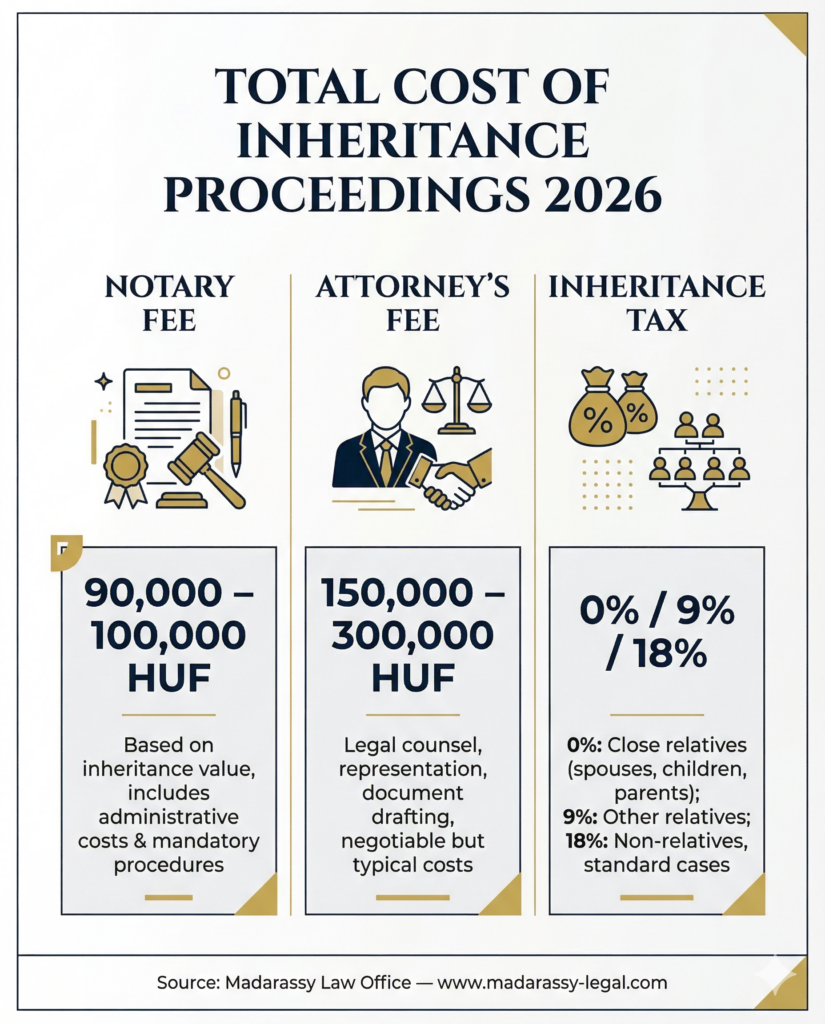
Probate attorney fees in Hungary 2026 are subject to free agreement, meaning there is no statutory scale. In practice, attorney fees typically range between 0.5% and 1% of the estate’s value, with a minimum fee threshold that in Budapest generally falls between HUF 80,000 and HUF 150,000 (approx. €200–€400). For an estate worth HUF 30 million (approx. €75,000), the attorney’s fee is typically between HUF 150,000 and HUF 300,000 (approx. €400–€800), while for a HUF 100 million estate the probate attorney fees in Hungary may reach HUF 500,000–HUF 1,000,000 (approx. €1,300–€2,600), depending on the complexity of the case.
When the attorney works on an hourly basis — which is common in contested matters or compulsory share disputes — the hourly rate in Budapest is generally between HUF 25,000 and HUF 60,000 (approx. €65–€155). This billing model is particularly appropriate when it is impossible to predict in advance how many hearings, submissions, or negotiations will be required. The engagement letter should always clearly set out the fee arrangement, the expected number of hours, and which activities are billed separately.
What is not included in the attorney’s fee?
It is important to understand that the attorney’s fee covers only the attorney’s work. It does not include the notary’s fee, inheritance tax, the land registry filing fee, or any expert fees that may arise. These items must be paid by the heir directly to the relevant authorities and professionals, in addition to the attorney’s fee. Many heirs miscalculate their costs because they only account for the legal representation, whereas the total cost of the proceedings can be three to four times higher — particularly when real estate forms part of the estate.
Inheritance lawyer fees (öröklés ügyvédi díj) are therefore just one component of the overall cost — though an important one worth planning for in advance. The following section sets out the other items to budget for.
How Much Does Probate Cost in Hungary Overall?
The notary’s fee — set by law, not negotiable
The notary’s fee is governed by Ministerial Decree No. 22/2018 (VIII. 23.) and cannot be negotiated — it is identical at every notary’s office. In probate proceedings, the notary charges half of the standard fee scale based on the estate’s value, to which a 40% cost allowance is added, along with any documented out-of-pocket expenses (postal, registry, and similar costs). For an estate worth HUF 30 million (approx. €75,000), the notary’s fee is approximately HUF 90,000–100,000 plus expenses (approx. €230–€260). For an estate of HUF 150 million (approx. €385,000), this can reach HUF 280,000–320,000 (approx. €720–€820). Where the estate’s value cannot be determined — for instance, when it consists solely of personal property — the notary charges an hourly rate, capped at three hours.
Inheritance tax in 2026 — exemptions in brief
The general rate of inheritance tax is 18%, with a reduced rate of 9% for residential property. However, the vast majority of inheritance cases are tax-exempt: direct-line relatives (children, parents, grandchildren, grandparents), spouses, registered partners, and — since 2020 — siblings all enjoy full exemption. Stepchildren and foster children are exempt up to HUF 20 million (approx. €50,000), and personal property below HUF 300,000 (approx. €770) is also exempt. Tax is assessed by the Hungarian Tax Authority (NAV) based on the grant of probate and must be paid within 30 days of receiving the assessment notice.
When Should You Hire a Probate Lawyer?
Disputed estates, multiple heirs, contested wills
Engaging a probate lawyer in Budapest or elsewhere in Hungary is particularly warranted when there is a dispute among heirs — for example, if someone challenges the validity of a will, if multiple heirs assert conflicting claims, or if the deceased left behind debts. Around 1,500 inheritance cases go to court in Hungary each year, and a significant proportion of them could have been avoided with timely legal advice. In a contested estate, the notary issues a provisional grant of probate, and the party wishing to challenge it must initiate court proceedings within 30 days — missing this deadline results in a permanent loss of rights. In such situations, hiring a probate lawyer is truly indispensable.
A similarly risky situation arises when a will suffers from formal deficiencies. In Budapest, 90% of formally defective wills are challenged — which itself illustrates why involving a lawyer in drafting and interpreting a will is important, not just on the day of the probate hearing. A large proportion of will templates circulating online contain formal errors that render the document entirely void.
Foreign heirs, debt-laden estates, compulsory shares
When an heir lives abroad, serving the summons can take months, and the hearing may be significantly delayed. In such cases, it makes good sense for the foreign heir to authorise a Hungarian attorney to represent them at the hearing — this avoids the delays associated with international postal correspondence. Where the estate includes debts, an attorney is invaluable in helping the heir assess whether accepting the inheritance is worthwhile or whether it would be more prudent to disclaim it. Enforcing a compulsory share (kötelesrész) also requires legal assistance, particularly where the deceased expressly excluded the entitled person from the will.

Common Mistakes Heirs Make Without a Lawyer
The dangers of not attending the hearing
One of the most frequent and consequential mistakes made without legal representation: an heir fails to appear at the probate hearing despite having been properly summoned, while the other heirs conclude an estate distribution agreement (osztályos egyezség). The agreement makes no provision for the absent heir’s compulsory share, since that heir made no statement. The compulsory share can subsequently be enforced only through litigation — which is far more costly and time-consuming than a simple power of attorney would have been. Missing a single hearing can therefore result in a serious financial loss.
The law does not prevent the hearing from proceeding in the absence of a summoned heir, and the decisions reached become legally binding. Recovering a right once lost through court proceedings can take years, with no guarantee of success. This is precisely the type of situation lawyers refer to when they say: “one hour of legal work would have prevented all of this.”
The trap of an invalid will
The other recurring pitfall is an invalid will. As noted above, a significant proportion of templates found online contain formal defects that render the document entirely void — the notary disregards the invalid instrument, and the statutory rules of intestate succession apply instead. This is particularly painful for those who deliberately intended to exclude a certain heir, or wished to benefit someone who would not otherwise inherit. A will drafted and countersigned by an attorney, or executed before a notary, is by contrast legally robust and far harder to challenge.
How to Calculate the Total Cost of Probate in Advance
Sample calculations: estates of HUF 30 million, HUF 80 million, and HUF 150 million
Three items must be considered when calculating the total cost: the notary’s fee, the attorney’s fee (if engaged), and inheritance tax (if the heir is not exempt). The table below is indicative; actual figures will depend on the complexity of the case and the terms agreed with the attorney.
| Estate value | Notary’s fee (approx.) | Attorney’s fee (approx., 0.5–1%) | Inheritance tax (9%, if payable) |
|---|---|---|---|
| HUF 30M (approx. €75,000) | HUF 90,000–100,000 + expenses | HUF 150,000–300,000 | HUF 2,700,000 (residential property) |
| HUF 80M (approx. €205,000) | HUF 130,000–160,000 | HUF 400,000–800,000 | HUF 7,200,000 (residential property) |
| HUF 150M (approx. €385,000) | HUF 280,000–320,000 | HUF 750,000–1,500,000 | HUF 13,500,000 (residential property) |
It is worth emphasising that inheritance tax for direct-line relatives, spouses, partners, and siblings is zero — meaning this largest potential item does not arise in the majority of cases. The tax figures in the table apply to heirs who are not exempt, such as more distant relatives or unregistered partners.
When does hiring an attorney make financial sense?
The return-on-investment calculation is straightforward: if engaging a probate lawyer Budapest or elsewhere saves you from litigation — the minimum cost of which runs to several hundred thousand forints — the attorney’s fee is a fraction of that. Where a compulsory share is at stake and the heir’s claim runs to millions of forints, the attorney’s fee is a relatively low entry cost. For a straightforward, uncontested single-property estate where there is no conflict among the statutory heirs, legal representation may genuinely be optional — the heir can appear in person, and the notary conducts the proceedings impartially. The decision should always be based on the specific circumstances of the case. If in doubt, seek an initial consultation — many firms offer this free of charge.
What to Look for When Choosing a Probate Lawyer in Budapest
What makes a good probate lawyer? — capacity, availability, transparent fees
When choosing the right probate lawyer, the first consideration is genuine capacity: an overloaded attorney responds slowly, misses deadlines, and cannot give the case the attention it deserves. It is well worth steering the conversation at the first consultation towards how many active files the attorney is currently handling, and whether there is office support — an assistant or colleague — to ensure efficient administration. Availability and communication style are equally telling: a good lawyer explains the process clearly at the first meeting, does not deflect questions, and does not create unnecessary uncertainty. Transparent fee arrangements are a basic requirement: fees set out precisely in the engagement letter prevent misunderstandings down the line.
What does experience really mean? — caseload, client types, proportion of contested matters
“Experience in inheritance law” on its own says very little — the relevant question is what types of cases the attorney has actually handled. Someone who works primarily on simple, uncontested matters may not be the right choice for a complex will challenge. It is worth steering the conversation at the first consultation: has the attorney conducted probate litigation before a court? Have they handled compulsory share claims? Have they dealt with cases involving foreign heirs, or the inheritance of business interests? The attorney’s answers will reveal the depth of practical knowledge they bring to your specific situation — and that is the kind of experience that actually matters.
Summary — Key Points for Every Heir
The most important steps before the hearing
How smoothly the probate proceedings go depends largely on how well-prepared the heirs are. As accurate a picture as possible of the deceased’s assets, bank accounts, properties, and any outstanding debts should be provided to the municipal administrator responsible for compiling the estate inventory — the more complete the inventory, the faster the proceedings. If the deceased left a will, it should be located and reported as soon as possible. Where any disagreement is expected among heirs — over the division of assets, the terms of the will, or the decision to accept or disclaim the inheritance — legal consultation should take place before the hearing, not after.